In this article· 17 sectionsJump to any section of the article
- 1Table of Contents
- 2What Is API Security Testing?
- 3Why API Security Testing Matters
- 4The OWASP API Security Top 10
- 5Types of API Security Tests
- 6Top API Security Testing Tools
- 7API Security Testing Methodology (Step by Step)
- 8Automated API Security Testing
- 9Beyond Testing: Runtime API Protection
- 10REST API Security Testing Checklist
- 11Frequently Asked Questions
- 12Conclusion
Modern applications run on APIs. Mobile apps, single-page frontends, microservices, partner integrations, and now AI agents all talk to each other through them, and every one of those endpoints is a potential way in. That is exactly why API security testing has moved from a nice-to-have to a core engineering practice. Back in 2021, Gartner predicted that APIs would become the most frequent attack vector, and the years since have proven the call right.
The catch is that the testing most teams already run does not cover APIs well. Functional API tests confirm that an endpoint returns the right data; traditional web DAST scanners crawl a browser-driven UI and never reach the endpoints that have no front end at all. Security testing built specifically for APIs is what closes that gap.
This guide covers what API security testing is, the OWASP API Security Top 10 that frames it, the types of tests you should run, the tools worth knowing, a step-by-step methodology with copy-pasteable examples, how to automate it in CI/CD, and a checklist you can use today. It ends with the part most guides skip: what to do once testing is done and your API is live under real traffic.
Table of Contents
- What Is API Security Testing?
- Why API Security Testing Matters
- The OWASP API Security Top 10
- Types of API Security Tests
- Top API Security Testing Tools
- API Security Testing Methodology (Step by Step)
- Automated API Security Testing
- Beyond Testing: Runtime API Protection
- REST API Security Testing Checklist
- Frequently Asked Questions
What Is API Security Testing?
API security testing is the practice of evaluating an API for security weaknesses by sending crafted requests and analyzing how it responds. The goal is to find flaws an attacker could exploit, such as broken authorization, weak authentication, injection, excessive data exposure, and missing rate limits, before they reach production.
It is not the same as functional API testing. Functional testing asks “does this endpoint return the correct response for a valid request?” Security testing asks “what happens when I send a request the endpoint was never meant to handle?” That includes requests carrying another user’s object ID, a tampered JWT, an oversized payload, or an injection string in a parameter.
API security testing applies across REST, GraphQL, gRPC, and SOAP interfaces, and it spans the whole development lifecycle. In practice it combines four techniques: static analysis of the code that implements the API, dynamic testing against a running instance, fuzzing with malformed input, and manual penetration testing for the business-logic flaws that automated tools cannot reason about.
Why API Security Testing Matters
APIs are now the primary attack surface for most applications, and the data backs it up. In Salt Security’s Q1 2025 State of API Security Report, 99% of surveyed organizations had run into an API security problem in the previous year, and roughly one in three had suffered an actual API breach.
Two structural problems make APIs hard to defend. First, they multiply faster than security keeps up: the same research found many organizations growing their API count by more than 50% year over year, while 58% monitor their APIs less than once a day. Endpoints that nobody is watching are the ones that get hit. Second, most API attacks look legitimate. Reporting around the 2025 data notes that the vast majority of API attacks (around 95%) originate from authenticated sources using valid but stolen credentials or keys, which means they sail straight past authentication checks and signature-based filters.
That combination, an exploding attack surface plus attacks that blend into normal traffic, is precisely why testing APIs on their own terms matters. A generic web scan was never designed for it.
The OWASP API Security Top 10
The OWASP API Security Top 10 is the industry-standard list of the most critical API risks, maintained by the Open Worldwide Application Security Project (OWASP). The current edition dates to 2023. Structuring your testing around it ensures you cover what attackers actually exploit, in roughly the order they exploit it.
| ID | Risk | What to test for |
|---|---|---|
| API1:2023 | Broken Object Level Authorization (BOLA) | Whether one user can access another user’s objects by changing an ID |
| API2:2023 | Broken Authentication | Weak or non-expiring tokens, credential stuffing, JWT signature flaws |
| API3:2023 | Broken Object Property Level Authorization | Over-exposed response fields or mass assignment of restricted ones |
| API4:2023 | Unrestricted Resource Consumption | Missing rate limits, pagination abuse, expensive queries |
| API5:2023 | Broken Function Level Authorization | Regular users reaching admin-only functions or methods |
| API6:2023 | Unrestricted Access to Sensitive Business Flows | Automated abuse of flows like checkout, signup, or password reset |
| API7:2023 | Server-Side Request Forgery (SSRF) | Whether user-supplied URLs make the server fetch internal resources |
| API8:2023 | Security Misconfiguration | Verbose errors, missing headers, permissive CORS, default settings |
| API9:2023 | Improper Inventory Management | Undocumented, deprecated, or shadow endpoints still serving traffic |
| API10:2023 | Unsafe Consumption of APIs | Trusting third-party API responses without validation |
Broken Object Level Authorization (API1) deserves special attention. It is consistently the most exploited API flaw, and it is invisible to a scanner that does not understand which user owns which object. Testing for it means authenticating as two different users and confirming that user A cannot read or modify user B’s resources. For the wider context of how these risks map to general application security, our OWASP Top 10 guide covers the parent framework.
Types of API Security Tests
No single technique finds everything. A mature API security testing program layers four of them.
Static Application Security Testing (SAST) analyzes the API’s source code without running it. It catches hardcoded secrets, insecure deserialization, and injection sinks early, during development. Its blind spot is business logic, because it never executes the code.
Dynamic Application Security Testing (DAST) tests a running API by sending real requests. API-aware DAST tools import an OpenAPI/Swagger or GraphQL schema so they exercise every documented endpoint, not just the ones a UI happens to touch. This is where injection, misconfiguration, and authentication issues surface in a live system.
Fuzzing floods endpoints with malformed, unexpected, or random input to surface crashes, unhandled exceptions, and edge-case vulnerabilities. It is particularly good at the input-validation gaps that hand-written test cases never think to try.
Penetration testing is manual, human-driven work by a security engineer who chains findings together and probes business logic. BOLA, broken function-level authorization, and sensitive-flow abuse usually demand this kind of reasoning. For a deeper comparison of how these approaches relate, including where runtime fits, see our guide on SAST vs DAST vs IAST vs RASP.
Top API Security Testing Tools
The right tool depends on which test type you are running and where in the pipeline it sits. Here are the ones worth knowing, grouped by what they do best.
| Tool | Type | Open source | Best for |
|---|---|---|---|
| OWASP ZAP | DAST / scanner | Yes | Free, scriptable API scanning with OpenAPI import; ideal for CI |
| Burp Suite | DAST / manual pentest | Community + paid | Deep manual testing and interception of complex API flows |
| Postman | Functional + basic security | Freemium | Auth testing, schema validation, scripted security checks |
| 42Crunch | API contract security | No | Shift-left auditing of OpenAPI definitions before deploy |
| Schemathesis | Fuzzing (spec-based) | Yes | Property-based fuzzing generated from an OpenAPI/GraphQL schema |
| Akto | DAST / API discovery | Community + paid | Endpoint discovery plus test cases mapped to the OWASP API Top 10 |
A capable starting stack can cost nothing: OWASP ZAP for automated DAST, Schemathesis for spec-based fuzzing, and Postman for auth and contract checks, with Burp Suite added when you need serious manual work. The “best api security testing tools” for your team come down to your stack, your CI cadence, and whether you need REST, GraphQL, or gRPC coverage, so treat any ranked list (including this one) as a starting point rather than a verdict.
API Security Testing Methodology (Step by Step)
A repeatable REST API security testing process looks like this.
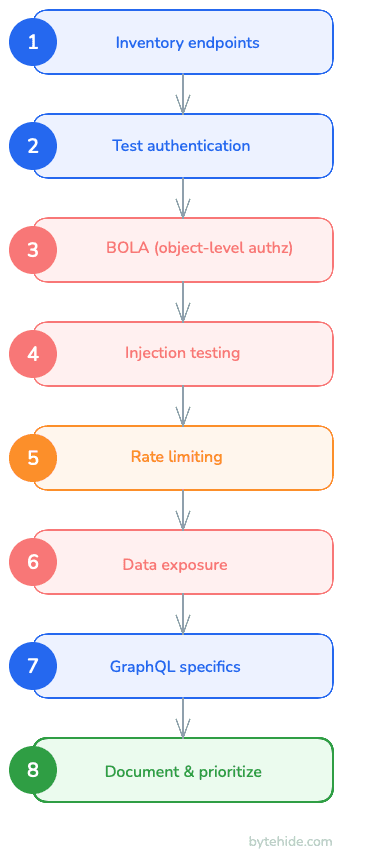
1. Inventory every endpoint. You cannot test what you do not know exists. Pull your OpenAPI/Swagger spec and reconcile it against real traffic to catch shadow and deprecated endpoints (OWASP API9).
2. Test authentication. Confirm that tokens expire, cannot be forged, and are validated on every request. A fast check that a tampered JWT is rejected:
# Send a request with a JWT whose signature has been altered.# A correctly configured API must return 401, never 200.curl -i <https://api.example.com/v1/account> \\ -H "Authorization: Bearer eyJhbGciOiJIUzI1NiJ9.eyJ1c2VyIjoiMSJ9.TAMPERED_SIGNATURE"3. Test object-level authorization (BOLA / API1). Authenticate as user A, then try to read a resource that belongs to user B by changing the ID:
# Logged in as user A, request an object owned by user B (id 102).curl -i <https://api.example.com/v1/users/102/orders> \\ -H "Authorization: Bearer $USER_A_TOKEN"# Expected: 403 Forbidden or 404 Not Found# Vulnerable: 200 OK returning user B's orders4. Test input validation and injection. Send injection payloads in parameters, headers, and JSON bodies:
# Probe a query parameter for SQL injection.curl -i "<https://api.example.com/v1/products?search=>' OR '1'='1" \\ -H "Authorization: Bearer $TOKEN"# A 500 error or an altered result set signals improper input handling.5. Test rate limiting and resource consumption (API4). Fire a burst of requests and confirm the API throttles you with HTTP 429 instead of processing every one.
6. Test for excessive data exposure (API3). Inspect responses for fields the client never needs: internal IDs, password hashes, tokens, or PII that should be filtered server-side.
7. Cover GraphQL specifics, if relevant. Confirm introspection is disabled in production and that query depth and complexity limits are enforced, so a single nested query cannot exhaust the server.
8. Document and prioritize. Map each finding to its OWASP API category and severity, then route it to the team that owns the endpoint, with a reproducible request attached.
Automated API Security Testing
Automated API security testing runs these checks on every build instead of once a quarter. Wiring an API-aware scanner into CI catches regressions the moment they are introduced. Here is a minimal GitHub Actions job that runs OWASP ZAP against an API described by an OpenAPI spec:
# .github/workflows/api-security.ymlname: API Security Testingon: [pull_request]jobs: zap-api-scan: runs-on: ubuntu-latest steps: - name: Run OWASP ZAP API scan uses: zaproxy/action-api-scan@v0.9.0 with: target: '<https://staging.example.com/openapi.json>' format: openapi # ZAP reads the spec and tests every endpoint fail_action: true # fail the build on new High-risk alertsAutomation has limits worth being honest about. In my experience, the teams that get breached are rarely the ones missing a scanner; they are the ones who never tested authorization between two real user accounts. Scanners and fuzzers are excellent at injection, misconfiguration, and known patterns, but they cannot reason about business logic, so BOLA and sensitive-flow abuse still need periodic manual penetration testing. Treat automation as your safety net for regressions and manual testing as your depth.
Beyond Testing: Runtime API Protection
Testing is a shift-left activity: it finds vulnerabilities before code ships. But two realities mean testing alone is never enough. First, no test suite is complete, and zero-days exist by definition. Second, as the 2025 data showed, most API attacks arrive as authenticated, legitimate-looking traffic that no pre-deployment test would flag. The request itself is valid; the intent is not.
That is the gap runtime API protection fills. Where testing inspects the API before deployment, runtime protection observes it in production, watching the actual requests hitting live endpoints and reacting to abuse as it happens. The two are complementary layers of one goal, not competing options: shift-left testing reduces the vulnerabilities that reach production, and shift-right runtime defense catches what testing could not anticipate.
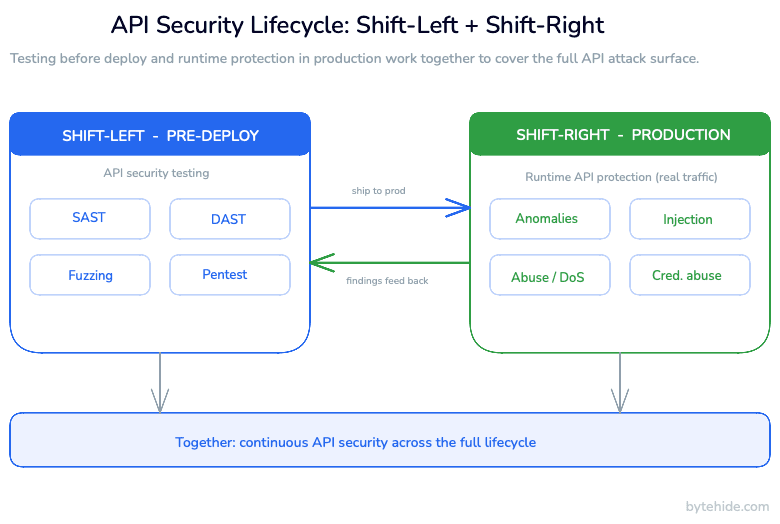
That second layer is where tools like ByteHide App Runtime come in. Its API Behavior Defense capability works at the application layer, inside the running process, monitoring API behavior to spot injection attempts, credential abuse, and anomalous access patterns against real traffic. Because it sees each request in the context of the application (which user, which object, which function), it can surface the authorization abuse, like BOLA, that perimeter tools and signature scanners miss. It complements an API gateway or WAF rather than replacing it: the gateway filters at the edge, while App Runtime understands intent at the code level. If you want to see how runtime protection compares to perimeter defenses, our RASP vs WAF guide breaks it down.
REST API Security Testing Checklist
Use this as a repeatable testing pass. It covers what to test, not what to configure. For the implementation and best-practices side, see our API security checklist organized by the OWASP API Top 10.
- [ ] Inventory and reconcile all endpoints against the OpenAPI spec (catch shadow and deprecated APIs)
- [ ] Verify authentication on every endpoint, including token expiry and tampering
- [ ] Test object-level authorization (BOLA): user A cannot access user B’s objects
- [ ] Test function-level authorization: regular users cannot reach admin methods
- [ ] Test for excessive data exposure and mass assignment
- [ ] Send injection payloads (SQLi, NoSQLi, command, template) in params, headers, and bodies
- [ ] Fuzz endpoints with malformed and oversized inputs
- [ ] Confirm rate limiting returns 429 under burst load
- [ ] Test for SSRF on any parameter that accepts a URL
- [ ] Check error responses for stack traces, internal IDs, and verbose messages
- [ ] Verify security headers and CORS configuration
- [ ] Test GraphQL-specific risks (introspection disabled, query depth and complexity limits)
- [ ] Map every finding to its OWASP API Security Top 10 category and severity
- [ ] Re-test after fixes and add a regression test to CI
Frequently Asked Questions
What is the difference between API testing and API security testing?
Functional API testing verifies that an endpoint behaves correctly for valid input, returning the right data and status codes. API security testing verifies that an endpoint resists invalid and malicious input, checking for issues like broken authorization, injection, and data exposure. You need both, because they answer different questions.
Which tool is best for API security testing?
There is no single best tool; it depends on the test type. OWASP ZAP is the strongest free option for automated DAST and CI integration, Burp Suite leads for manual penetration testing, Schemathesis is excellent for spec-based fuzzing, and 42Crunch focuses on auditing OpenAPI definitions before deployment. Most teams combine two or three.
How often should you run API security tests?
Automated tests should run on every pull request or build so regressions are caught immediately. Full manual penetration testing is typically done quarterly and before any major release. APIs that handle sensitive data or change frequently warrant more frequent manual review.
Can API security testing be automated?
Partially. DAST scanning, spec-based fuzzing, and contract validation automate well and belong in CI/CD. Business-logic flaws such as BOLA and sensitive-flow abuse require human reasoning and cannot be fully automated, so a mature program pairs automated testing with periodic manual pentesting and runtime monitoring.
What is the OWASP API Security Top 10?
It is the industry-standard list of the ten most critical API security risks, published by OWASP, with the current edition dating to 2023. It includes Broken Object Level Authorization (BOLA), Broken Authentication, and Unrestricted Resource Consumption, among others, and it is the recommended framework to structure API security testing around.
Conclusion
API security testing is no longer optional, and doing it well means going deeper than a generic web scan:
- Structure your testing around the OWASP API Security Top 10, and give Broken Object Level Authorization (API1) the attention it deserves as the most exploited API flaw.
- Layer the four test types: SAST in development, DAST and fuzzing in CI, and manual penetration testing for business logic.
- Automate the repeatable checks so regressions fail the build, and reserve manual testing for depth.
- Remember that testing is shift-left. Because most API attacks use legitimate-looking authenticated traffic, pair testing with runtime API protection to cover what pre-deployment testing cannot.
Testing tells you where your API is weak before you ship. Runtime protection defends it once it is live. If closing that second gap is on your roadmap, ByteHide App Runtime adds runtime API protection that monitors live traffic for injection, abuse, and authorization attacks at the application layer, so the vulnerabilities a test suite could not anticipate do not turn into breaches.